
Truth Telling Lesson Plan for Ages 3 to 8 with Song Story and Activity Sheets

Children often understand the word “truth” before they understand why honesty can feel hard. A broken crayon, a spilled cup, a hidden toy, or a mistake during play can turn into a big emotional moment. This lesson uses music, story, movement, discussion, and a simple activity sheet to help young children practice telling the truth in a safe, encouraging way.
This truth telling lesson plan centers on the song “Tell The Truth (Even When It’s Tough)” and works well for preschool, kindergarten, early elementary classrooms, homeschool groups, Sunday school, library story time, or family learning time.

Lesson goals and expected outcomes
Lesson length
About 45 to 60 minutes, with simple options to shorten or extend.
Age range
Children ages 3 to 8
Big idea
Telling the truth can feel hard, but honesty helps people build trust, solve problems, and make things right.
Lesson goals
By the end of the lesson, children will:
Understand that telling the truth means saying what really happened.
Recognize that everyone makes mistakes.
Practice simple words for telling the truth.
Notice how honesty can help repair trust.
Connect the message of the song to a story and activity sheet.
Expected outcomes
Children should be able to:
Name one reason it is good to tell the truth.
Use a sentence such as, “I made a mistake,” or “This is what happened.”
Identify honest choices in a story or picture.
Complete an age-appropriate activity sheet about truth telling.
Show respect when someone else tells the truth.
A helpful message for young children is simple: “The truth helps us fix the problem.”
Materials needed for the lesson
Gather these materials before the lesson begins:
A device to play the song video
Speakers or a classroom screen
A related story about honesty
Printed activity sheets
Crayons, pencils, or markers
Chart paper or a whiteboard
A small stuffed animal, puppet, or classroom mascot
Stickers or stamps for completed work, optional
Suggested story choices
Choose one age-appropriate book or story about honesty, mistakes, or making things right. Good story types include:
A child accidentally breaks something and tells the truth.
A character takes something that does not belong to them and admits it.
A friend tells the truth even though they feel nervous.
A character learns that blaming others hurts trust.
If you do not have a book ready, use the short original story included later in this lesson.
Lesson at a glance
Lesson part | Time | What children do |
Welcome and warm-up | 5 minutes | Talk about what truth means |
Song listening | 5 to 7 minutes | Watch and listen to the song |
Song discussion and motions | 7 to 10 minutes | Talk, repeat key phrases, and move |
Story time | 10 to 15 minutes | Read or listen to a story about honesty |
Activity sheet | 12 to 18 minutes | Draw, circle, color, or write |
Share and close | 5 minutes | Name one honest choice |
For ages 3 to 4, keep the lesson closer to 35 to 45 minutes and use more movement. For ages 6 to 8, extend discussion, writing, and role-play.
Start with a gentle honesty warm-up
Begin with a calm, clear invitation.
Say:
“Today we are learning about telling the truth. The truth means saying what really happened. Sometimes telling the truth feels easy. Sometimes it feels tough. We are going to learn a song that helps us remember what to do.”
Hold up a stuffed animal or puppet. Give it a simple problem.
For example:
“Our puppet knocked over the block tower. The puppet feels worried. What could the puppet say?”
Let children respond. If needed, offer sentence starters:
“I knocked it over.”
“I made a mistake.”
“I can help fix it.”
“I am sorry.”
Keep the tone warm. The goal is not to shame the puppet. The goal is to show that mistakes can be repaired.
Listen to “Tell The Truth (Even When It’s Tough)”
Introduce the song as the main anchor for the lesson. Ask children to listen for words or ideas about honesty.
<iframe width="560" height="315" src="https://www.youtube.com/embed/OkAaNc2-8Vc?si=fOUYBfMsK3qMC1j_" title="Tell The Truth (Even When It's Tough) YouTube video player" frameborder="0" allowfullscreen></iframe>
If your setting does not allow embedded video, use this link: Watch “Tell The Truth (Even When It’s Tough)” on YouTube
First listen
Ask children to listen quietly or clap softly to the beat. Younger children can pat their knees or sway.
After the song, ask:
“What did the song say about telling the truth?”
“When might telling the truth feel tough?”
“How can someone feel better after telling the truth?”
Accept short answers. Some children may say, “I don’t know.” That is fine. Offer examples.
“Sometimes it feels tough when we broke something, forgot a rule, or hurt someone’s feelings. Telling the truth helps grown-ups help us.”
Second listen with motions
Play the song again. Add simple motions so children can connect the words to action.
Use motions like these:
Point to mouth for “tell.”
Touch heart for “truth.”
Make strong arms for “tough.”
Open hands for “I can fix it.”
Thumbs up for “honest choice.”
For ages 3 to 5, repeat only two or three motions. For ages 6 to 8, let children create their own motions for the chorus or a repeated phrase.

Read a related story about honesty
Plan 10 to 15 minutes for reading. Younger children may need a shorter story with more picture talk. Older children can handle more discussion.
Before reading, say:
“Stories help us see what honesty looks like. Listen for the moment when the character has to choose what to say.”
Use a favorite honesty book
If you have a storybook about honesty, read it aloud. Pause at key moments and ask:
“What happened?”
“How does the character feel?”
“What could the character say?”
“What choice would build trust?”
Keep the questions simple. For younger children, offer two choices.
“Should the character hide the mistake or tell what happened?”
Read this original mini story if you need one
Maya and the Blue Paint
Maya loved painting at the art table. She dipped her brush into blue paint and made a big circle. Then she reached across the table for yellow paint.
Bump!
The blue paint cup tipped over. Paint ran across the table and dripped onto the floor.
Maya froze. Her teacher was helping another child. Maya looked at the paint. Then she looked at the shelf. She thought about walking away.
Her friend Leo said, “Oh no. What happened?”
Maya whispered, “I spilled it.”
Her tummy felt tight. She did not want to get in trouble. But she remembered, “The truth helps us fix the problem.”
Maya raised her hand. “I spilled the blue paint,” she said. “It was an accident. Can I help clean it?”
Her teacher came over with paper towels. “Thank you for telling the truth,” the teacher said. “Accidents happen. Let’s clean it together.”
Maya helped wipe the table. Leo helped pick up the brushes. Soon the art table was ready again.
Maya felt lighter inside. Telling the truth had felt tough, but it helped make things right.
Story discussion
After the story, use a few focused questions.
For ages 3 to 5:
“What spilled?”
“Did Maya tell the truth?”
“How did Maya help?”
For ages 6 to 8:
“Why did Maya think about walking away?”
“What made telling the truth hard?”
“How did the teacher respond?”
“What can we learn from Maya?”
Write one sentence on chart paper:
Telling the truth helps us fix the problem.
Read it together.
Complete the truth telling activity sheet
Plan 12 to 18 minutes for activity sheets. This part lets children show what they learned in a quiet, hands-on way.
Use one sheet for all children, or offer two levels.
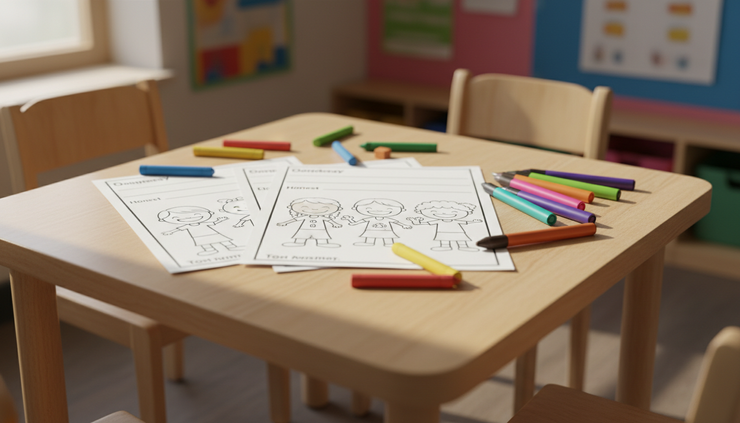
Activity sheet option for ages 3 to 5
Use a simple picture-based sheet.
Title
“I Can Tell the Truth”
Sections to include
Circle the child who tells what really happened.
Color the heart when the child makes an honest choice.
Draw a face that shows how you feel after telling the truth.
Trace the words: “I tell the truth.”
Read each direction aloud. Keep the pace relaxed.
If a child is still developing fine motor skills, allow pointing instead of circling, scribble coloring, or verbal answers.
Activity sheet option for ages 6 to 8
Use a sheet with pictures and short writing.
Title
“Even When It’s Tough, I Can Tell the Truth”
Sections to include
Read three short situations.
Circle the honest choice.
Write one sentence the child could say.
Draw a picture of someone making things right.
Finish the sentence: “Telling the truth helps because…”
Example situations:
You knocked over someone’s blocks by accident.
You used a marker on the table.
You forgot to put away a toy and someone asks what happened.
Possible sentence starters:
“I did it by accident.”
“I made a mistake.”
“I can help clean it.”
“I will tell what happened.”
Teacher or parent support during work time
Walk around while children work. Notice effort, not perfection.
Helpful comments include:
“You found the honest choice.”
“That sentence would help solve the problem.”
“Your picture shows someone making it right.”
“Thank you for thinking carefully.”
If a child shares a real mistake, respond gently. Avoid turning the moment into a public correction. Say, “Thank you for telling the truth. We can talk about that together.”
Add role-play for deeper practice
If time allows, add 5 to 10 minutes of role-play after the activity sheet.
Role-play helps children practice honest words before they need them in real life. Keep scenarios light and common.
Try these quick scenes:
Situation | Honest words to practice |
A cup of water spills | “I spilled it. Can I help wipe it?” |
A toy breaks during play | “It broke while I was using it.” |
A child colors on the wrong paper | “I used the wrong paper by mistake.” |
A friend’s block tower falls | “I bumped it. I am sorry.” |
Let children act out both parts, the child telling the truth and the helper responding kindly.
Teach the helper response too:
“Thank you for telling me. Let’s fix it.”
This matters because children are more likely to tell the truth when they believe adults will help them repair the problem.
Differentiate for ages 3 to 8
A lesson for ages 3 to 8 needs flexible expectations. The same message works for everyone, but the task should match the child’s stage.
Ages 3 to 4
Keep it concrete.
Use simple language:
“Truth means what really happened.”
“A mistake can be fixed.”
“We can say, ‘I did it.’”
Best activities:
Singing
Motions
Pointing to pictures
Coloring
Puppet practice
Avoid long explanations. Repeat the same phrase often.
Ages 5 to 6
Children in this range can begin explaining feelings and choices.
Try questions like:
“Why was it hard to tell?”
“What happened after the truth?”
“How did the friend feel?”
Best activities:
Circle-the-choice sheets
Drawing a solution
Short role-play
Repeating honest sentence starters
Ages 7 to 8
Older children can talk about trust, responsibility, and repair.
Try questions like:
“How does honesty build trust?”
“What happens when someone lies?”
“How can a person make things right after a mistake?”
Best activities:
Writing short responses
Partner role-play
Creating a class honesty pledge
Sorting choices into “builds trust” and “breaks trust”
Build a safe classroom message around honesty
Truth telling lessons work best when children know that honesty will be met with calm guidance. The lesson should not make children afraid of consequences. Instead, it should show that truth is the first step toward repair.
Use this simple class promise:
When we tell the truth, we can get help, fix mistakes, and rebuild trust.
Create a small anchor chart with three steps:
Say what happened.
Say how you can help.
Try again.
Read the steps together after the song, after the story, and before the activity sheet.

Close the lesson with reflection
Bring children back together for a short closing circle. Hold the puppet or stuffed animal again.
Ask:
“What can we say when we make a mistake?”
Invite children to answer together:
“I can tell the truth.”
Then ask each child to share one of these:
One honest sentence they can use
One way to fix a mistake
One thing they remember from the song
One thing Maya did in the story
End with a calm reminder:
“Everyone makes mistakes. Telling the truth helps us get help and make things right. Even when it feels tough, we can be brave and honest.”
If you want to extend the lesson through the week, replay the song during morning meeting, use the sentence starters after small conflicts, and keep the activity sheets in a folder as a reminder. Truth telling grows through practice, encouragement, and safe chances to try again.


Comments